Maths · P6 · Specimen 01 Maths Questions
· 26 Jun 2026, 12:51
· asked by maxloo
· resolved
Text size
100%
Answer
-
maxloo · 26 Jun 2026, 19:45 · official answer
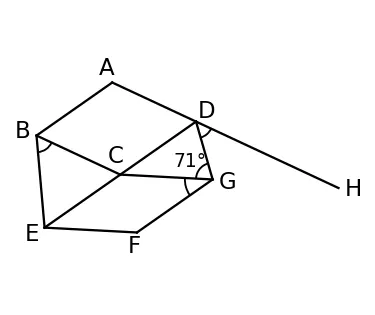
Since BE = CE and CD = CG, and ABCD and CEFG are rhombuses, CE = CG = CD = BC, So triangle BCE is an equilateral triangle.
$∠CBE$ = $\boxed{60°}$ $∠CDG$ = $∠CGD$ = $71°$ (Angles of isosceles triangle) $∠DCG$ = $180° - 71° - 71°$ (Angles of a triangle) = $38°$ Since ECD is a straight line,
$∠ECG$ = $180° - 38°$ (Angles on a straight line) = $142°$ $\Rightarrow$ $∠CGF$ = $\dfrac{1}{2}$ $\times$ $(360° - 142° - 142°)$ (Angles of a rhombus) = $\boxed{38°}$ $∠BCE$ = $60°$ (Angles of equilateral triangle) $∠BCD$ = $180° - 60°$ = $120°$ $∠CDA$ = $\dfrac{1}{2}$ $\times$ $(360° - 120° - 120°)$ (Angles of a rhombus) = $60°$ Since ADH is a straight line,
$∠GDH$ = $180° - 60° - 71°$ (Angles on a straight line) = $\boxed{49°}$