
Try Now — free Maths practice
This week's free PSLE-level Maths questions. Answer each one below and press Check for instant right-or-wrong feedback — no sign-up needed. We don't give the worked solution away: keep trying until you get the ✓. A fresh set is posted each week.
1. SP001 Maths Paper 1 Booklet A - Question 09
Arrange these distances from the shortest to longest.
$\boxed{9\ km\ 305\ m\ \ \ \ \ \ \ 9.35\ km\ \ \ \ \ \ \ 9\dfrac{3}{5}\ km}$
$\ \ \ \ \ Shortest\ \ \ \ \ \ \ \ \ \ \ \ \ \ Longest$
(1) $9\dfrac{3}{5}$ km , 9.35 km , 9 km 305 m
(2) 9.35 km , $9\dfrac{3}{5}$ km , 9 km 305 m
(3) $9\dfrac{3}{5}$ km , 9 km 305 m , 9.35 km
(4) 9 km 305 m , 9.35 km , $9\dfrac{3}{5}$ km
Your answer
2. SP001 Maths Paper 1 Booklet B - Question 19
Calculate the value of $\dfrac{9k+3}{6}$ when $k = 17$.
Ans: ______________
Your answer
3. SP001 Maths Paper 2 - Question 14
John had a piece of paper ABCD in the shape of a parallelogram.
He folded it along the line EF as shown below.
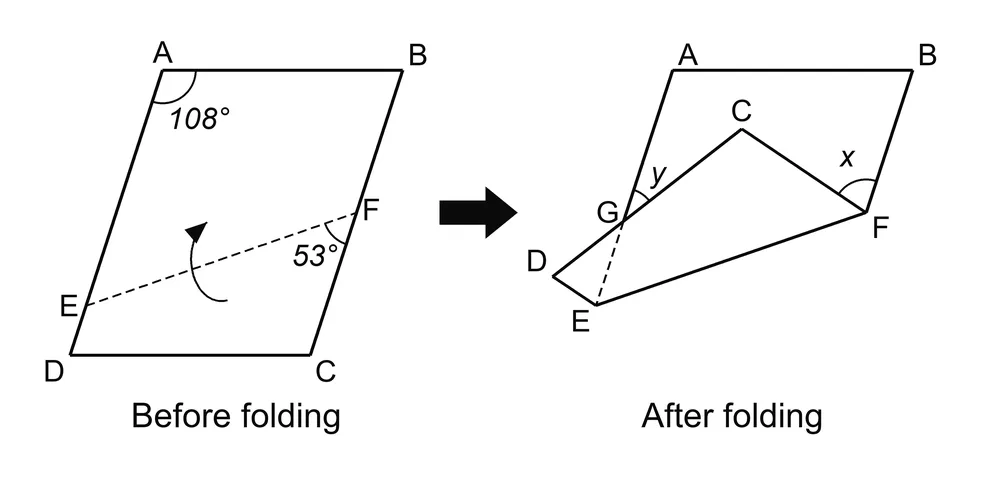
(a) What is $\angle$x?
(b) What is $\angle$y?
Ans: (a) ______________${}^{\circ}$ [1]
Ans: (b) ______________${}^{\circ}$ [3]
Your answers
4. SP001 Maths Paper 2 - Question 15
Peter used some wire to create the figure as shown.
There were 2 identical wire structures and they were joined with a piece of wire CD.
Each wire structure was formed by a large semi-circle, a small semi-circle and 2 straight lines.
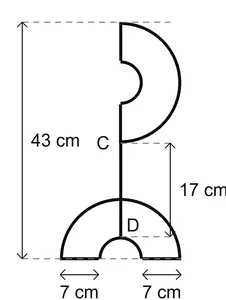
a) What is the radius of a small semi-circle?
b) What is the length of wire for making the figure?
(Take $\pi = 3.14$)
Ans: a) ______________$cm$ [2]
b) ______________$cm$ [2]
Your answers
Practise every day with a real tutor
These are just a taste. Registered students get the full Maths Practice Portal with worked answers revealed by a tutor. July FREE, then $30/subject/week.
WhatsApp +65 8757 1561 to Enquire